A façade that misses thermal targets by a small margin can reshape the economics of an entire scheme. Heating demand rises, frame depths increase, detailing becomes more difficult, and the promised comfort level is harder to achieve in practice. That is why the question of vacuum glass vs triple glazing matters well beyond product preference. For specifiers and project teams, it is a decision about buildability, energy performance, lifecycle value and compliance.
The two systems are often grouped together as high-performance glazing, but they solve the same problem in very different ways. Triple glazing improves insulation by adding another pane and another cavity, typically with inert gas fills and low-e coatings. Vacuum insulated glass achieves thermal performance by removing gas from the cavity altogether, sharply reducing conductive and convective heat transfer within a much slimmer build-up.
That difference has significant consequences. It affects centre-pane U-values, overall unit thickness, dead load, sightlines, retrofit viability, embodied carbon and long-term system behaviour. In demanding applications, those consequences are not marginal. They shape the specification.
Vacuum glass vs triple glazing: the core difference
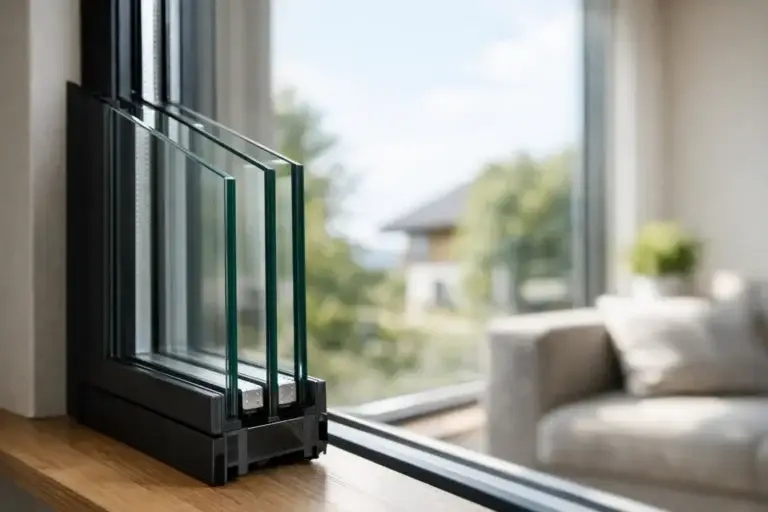
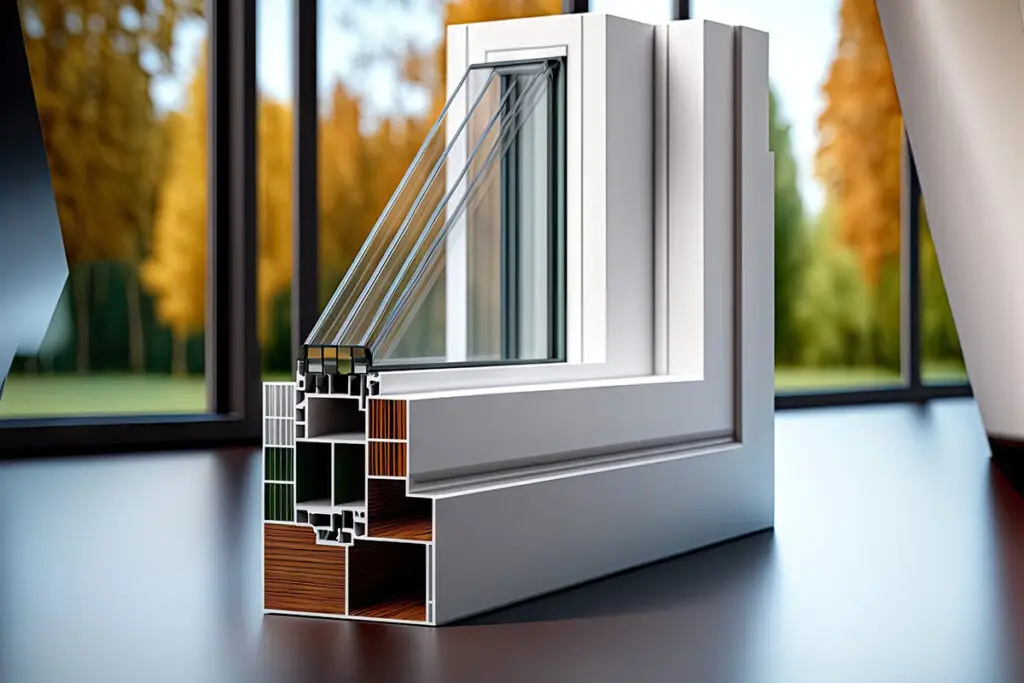
Triple glazing is a familiar route to better insulation. In most configurations, it uses three panes of glass separated by two cavities, with low-emissivity coatings and argon or krypton gas to reduce heat transfer. It is proven, widely available and effective when the frame system is designed to carry the additional thickness and weight.
Vacuum glass takes a more advanced engineering approach. Two panes are separated by a micro-thin vacuum space supported by discrete internal pillars, with edge sealing that maintains the vacuum over the service life of the unit. Because a vacuum contains almost no matter, it drastically cuts heat transfer through the cavity. The result is very low thermal transmittance without the bulk associated with triple glazed constructions.
This is the first major dividing line. Triple glazing adds layers to improve performance. Vacuum insulated glass changes the physics of the cavity itself.
Thermal performance is where the gap opens up
For many projects, the comparison starts and ends with U-value. That is reasonable, but only if the comparison is made properly. Centre-pane performance, whole-window performance and installed performance are not the same thing.
Triple glazing can deliver strong results, especially in carefully optimised systems. But to achieve lower U-values, it usually depends on larger overall build-ups, warm edge spacers, high-performance coatings and gas fills that must remain stable over time. Performance is good, but it comes with mass and thickness.
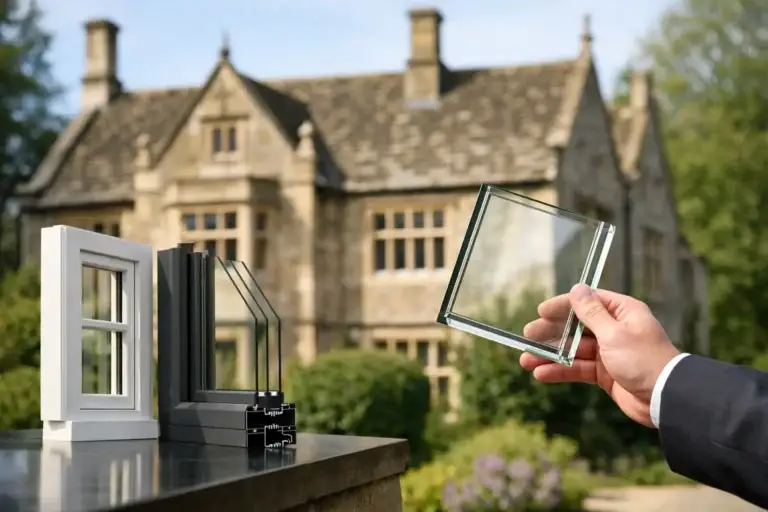
Vacuum insulated glass reaches exceptionally low centre-pane U-values in a much thinner profile. That gives designers more flexibility in achieving envelope targets without forcing oversized frames or deeper rebate details. On refurbishment projects, this is often decisive. Traditional sash, heritage frames and other constrained assemblies rarely welcome the thickness of triple glazing, whereas slim vacuum units can offer a route to substantial thermal improvement while preserving appearance and reducing intervention.
For Passive House, low-energy buildings and façades where every thermal bridge matters, the slimmer path to low U-values is not simply convenient. It can be the difference between a practical specification and a compromised one.
Thickness and weight are not secondary issues
The market often treats glazing thickness as a detail to resolve later. In reality, thickness drives frame design, transport, handling, fixing strategy and installation cost.
Triple glazed units are substantially thicker than vacuum glass. They are also heavier, because they use an additional pane and larger cavity build-ups. This affects more than structural loading. Heavier units slow installation, increase handling complexity and can push existing frames beyond their practical limits in refurbishment or replacement projects.
Vacuum insulated glass delivers high insulation in a much slimmer, lighter unit. That creates immediate project advantages. Frame sections can remain more refined, heritage sightlines are easier to protect, and transport and installation become less onerous. For high-rise, off-site manufacture and façade replacement programmes, reducing unit mass has obvious commercial value.
There is also a design dividend. When a project demands strong thermal performance without sacrificing slender profiles, vacuum glass gives the façade consultant more room to solve the detail cleanly.
Acoustic performance depends on the build-up
There is a common assumption that thicker automatically means quieter. That is too simplistic.
Triple glazing can provide very good acoustic control, but performance depends heavily on pane variation, cavity widths and the frequencies being targeted. In some configurations, the second cavity and additional pane help. In others, the gains are less pronounced than expected.
Vacuum glass also performs strongly in acoustic applications, particularly when engineered as part of a wider unit specification. The vacuum cavity changes sound transmission behaviour, and the overall build-up can be tailored with laminated panes or hybrid configurations where required. For projects near rail corridors, airports, city centres or industrial zones, the right answer is not based on a generic rule. It comes from tested performance data tied to the actual noise profile.
So on acoustics, the honest position is this: neither option wins by default in every scenario. But vacuum insulated glass should not be dismissed as the thinner option with weaker acoustic credentials. In many applications, it provides excellent sound reduction alongside superior thermal efficiency.
Durability and long-term value
Initial specification cost matters, but long-term value matters more on serious projects. A glazing system should be judged over its service life, not only at purchase.
Triple glazing relies on gas-filled cavities and multiple seals working effectively over time. It is a mature technology, but as with all insulated glass units, long-term performance depends on manufacturing quality, edge sealing and operating conditions. The more complex and heavier the unit, the more pressure there can be on system design and installation tolerances.
High-quality vacuum insulated glass is engineered for longevity, with a stable vacuum cavity and durable edge construction designed to maintain thermal performance over the long term. This is where product quality and manufacturing expertise matter enormously. A well-developed vacuum glass solution is not just thinner. It is a specialist insulated unit intended to deliver consistent performance through decades of service.
That durability has direct financial relevance. Lower heat loss reduces running costs. Lower weight can reduce strain on surrounding systems. Longer service life improves lifecycle economics. For commercial owners and developers, those are board-level considerations, not technical footnotes.
Embodied carbon and operational carbon
If the project team is measuring both embodied and operational carbon, the comparison becomes even more interesting.
Triple glazing can reduce operational energy demand, which is why it has become a standard route in many low-energy specifications. But it uses more material by definition – more glass, larger spacers, more bulk and more transport weight. That material intensity must be counted.
Vacuum insulated glass can offer a materially leaner route to very high thermal performance. With less overall thickness and no need for the same multi-cavity build-up, it has the potential to reduce material use while still driving down operational energy consumption. For specifiers trying to balance embodied carbon with in-use performance, that combination is attractive.
This is one reason vacuum glass is gaining ground in projects where sustainability targets are tied to measurable engineering outcomes rather than broad claims. Better insulation alone is no longer enough. The route taken to achieve it matters.
Where triple glazing still makes sense
A strong comparison needs to acknowledge trade-offs. Triple glazing remains a valid choice in many applications.
For standard new-build residential schemes with frame systems already designed around thicker units, triple glazing may provide a commercially acceptable route to compliance and comfort. Supply chains are familiar with it, installers are used to it, and up-front costs can appear more straightforward in commodity-led packages.
If the project has ample frame depth, modest design constraints and no strong pressure on unit thickness or weight, triple glazing can perform well. It is not obsolete. It is simply not the most advanced answer in every case.
Where vacuum insulated glass leads
Vacuum glass comes into its own when the brief is demanding. Heritage upgrades, high-performance façades, slim-frame designs, constrained rebates, premium residential, commercial refurbishment and projects targeting very low U-values all benefit from the same core advantage: maximum insulation with minimum thickness.
That is why specialist manufacturers such as Werkman Tech have positioned vacuum insulated glass as a direct upgrade path rather than a niche alternative. The value is measurable. Lower U-values, slimmer units, lower weight, strong acoustic capability and a greener material profile combine into a specification that solves multiple problems at once.
For architects and façade consultants, this reduces compromise. For contractors and fabricators, it can simplify difficult details. For building owners, it supports lower energy use and long-term asset performance.
Choosing the right specification
The best choice is not based on headline marketing. It comes from the project conditions.
If the priority is a familiar, widely available insulated unit for a conventional frame and a relatively standard performance target, triple glazing may be sufficient. If the priority is best-in-class thermal efficiency in the slimmest possible construction, vacuum insulated glass is the stronger technical solution.
That distinction matters because modern building standards are not moving towards lighter thermal demands. They are becoming stricter, and clients are becoming more focused on lifecycle value, carbon and comfort. In that context, glazing that achieves more with less thickness is not a niche proposition. It is a smarter response to where the market is going.
The useful question is no longer whether triple glazing is better than double glazing. For many advanced projects, the real question is whether triple glazing is enough for what the building needs next.