Road noise does not care how good your U-value looks on paper. In education, residential, hospitality and mixed-use schemes, complaints usually start with sound before anyone mentions heat loss. That is why acoustic vacuum glass performance deserves proper scrutiny at specification stage, not as a late-stage add-on once the façade package is fixed.
Vacuum insulated glass is often selected for its exceptional thermal capability, slim build-up and compatibility with demanding retrofit or new-build envelopes. Its acoustic behaviour can also be very strong, but it should not be treated as a one-line assumption. Sound reduction is influenced by the glass construction, pane thickness, edge seal design, frame, gasket strategy, installation quality and the frequency profile of the external noise source. For architects, façade consultants and contractors, the real question is not whether vacuum glass is good acoustically. It is how well a given configuration performs in a specific building condition.
What drives acoustic vacuum glass performance
The first point to understand is that thermal and acoustic performance are related, but they are not the same engineering problem. A vacuum cavity removes conductive and convective heat transfer between panes, which is why vacuum insulated glass can achieve very low centre-pane U-values in a slim unit. Sound transmission behaves differently. It depends on mass, stiffness, damping and resonance, not simply on whether the cavity contains gas or vacuum.
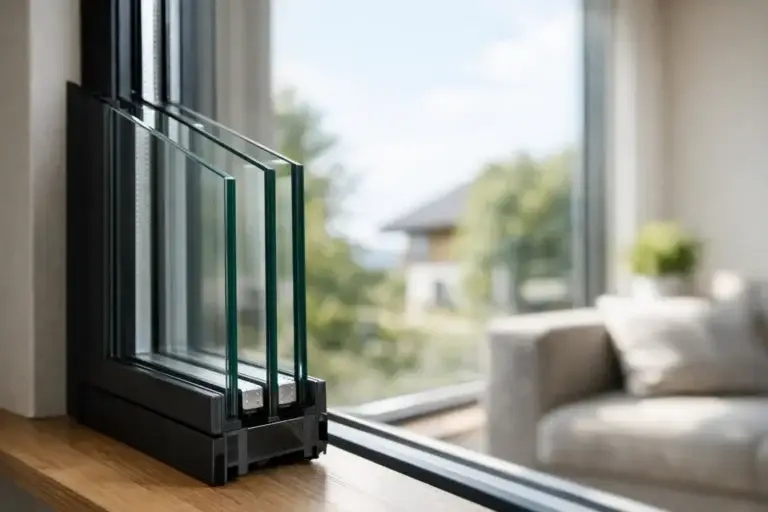
In practical terms, acoustic vacuum glass performance is shaped by several interacting factors. The thickness and make-up of the glass panes matter because heavier panes generally improve attenuation, particularly at certain frequencies. Laminated constructions can improve damping and help reduce sound transmission more effectively than monolithic panes in many use cases. The spacing concept is also different from conventional double glazing. Because a vacuum unit has a very narrow evacuated gap supported by micro spacers, its acoustic signature is not directly comparable with a wider cavity IGU on a like-for-like basis without reviewing test data.
That is where specification discipline matters. If the target is strong thermal insulation in a slim profile, vacuum glass is already in a leading position. If the target includes mitigation of traffic, rail, aircraft or city-centre noise, the unit build-up needs to be chosen around measured acoustic requirements rather than generic assumptions.
Why vacuum glass can perform well acoustically
A well-engineered vacuum insulated glass unit has two inherent advantages in many real projects. First, it delivers high thermal performance without the deep overall thickness of triple glazing. That allows specifiers to upgrade glazing performance where rebate depth, frame sightlines or heritage constraints would make thicker alternatives difficult. Second, because the system can be configured with laminated panes and other acoustic-conscious build-ups, it can combine low U-values with meaningful sound reduction in a single package.
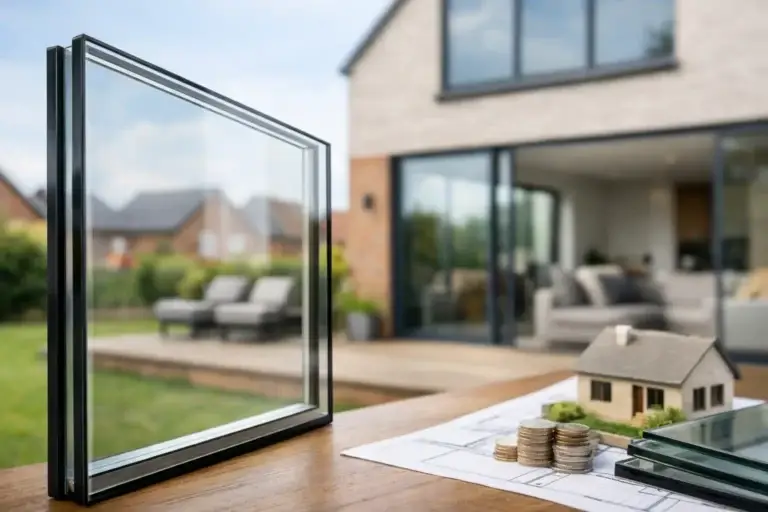
This matters commercially as much as technically. In urban residential schemes, hotel rooms, schools and offices near transport corridors, acoustic comfort affects occupancy quality, user satisfaction and operational value. A glazing specification that reduces heating demand but leaves occupants exposed to intrusive external noise is an incomplete solution. Vacuum glass gives specifiers a route to address both priorities while maintaining a slimmer construction than many conventional alternatives.
That said, the phrase “strong acoustic performance” must be grounded in tested results. External noise is frequency-dependent. Low-frequency lorry traffic and intermittent rail noise behave differently from speech, sirens or general city ambience. A unit that performs well in one noise environment may not be optimised for another. The right approach is to align the glass make-up with the measured acoustic brief.
Acoustic vacuum glass performance versus double and triple glazing
Comparisons with standard double glazing are usually favourable when vacuum insulated glass is properly specified. Basic double-glazed units often provide only moderate acoustic control, especially where pane thicknesses are symmetrical and framing or installation standards are ordinary. Vacuum glass can outperform such systems by combining a higher-performance overall construction with better thermal efficiency and less bulk.
The comparison with triple glazing is more nuanced. Triple-glazed units can achieve very good acoustic results, particularly when they use varied glass thicknesses and laminated panes. They also tend to be heavier and thicker, which creates implications for frame design, hardware, transport, handling and retrofit suitability. In projects where structural loading, sash weight, sightline retention or heritage detailing are under pressure, triple glazing can become difficult to accommodate even before cost and installation complexity are fully considered.
This is where vacuum insulated glass becomes strategically useful. It offers a slimmer route to premium thermal performance and can deliver impressive acoustic results without requiring the same depth and mass as triple glazing. But it is not a universal rule that every vacuum unit will beat every triple-glazed specification acoustically. If the project brief is dominated by severe external noise, the exact tested performance of the whole glazing system should decide the outcome.
The parts outside the glass matter just as much
Too many acoustic discussions stop at the glass datasheet. In occupied buildings, the frame and installation details often decide whether theoretical performance survives contact with the real façade.
Air leakage is a common weak point. Even small gaps around beads, seals, interfaces or opening lights can undermine acoustic control significantly. A premium glass unit fitted into an underperforming frame will not deliver a premium acoustic result. The same applies to poorly treated perimeter junctions, inconsistent sealant work and weak interfaces between curtain walling, masonry and internal linings.
Frame material and design also influence outcomes. The best acoustic vacuum glass performance is achieved when the whole assembly is considered as a system – glass, frame, gaskets, drainage strategy, fixings and perimeter installation. Opening windows deserve particular attention because vents, trickle components and operable hardware can become acoustic liabilities if they are not integrated carefully.
For façade consultants and contractors, this is not a detail issue. It is a performance issue. If the acoustic brief is contract-critical, tested whole-window or whole-system data carries more value than centre-pane claims alone.
Best-fit applications for acoustic vacuum glass performance
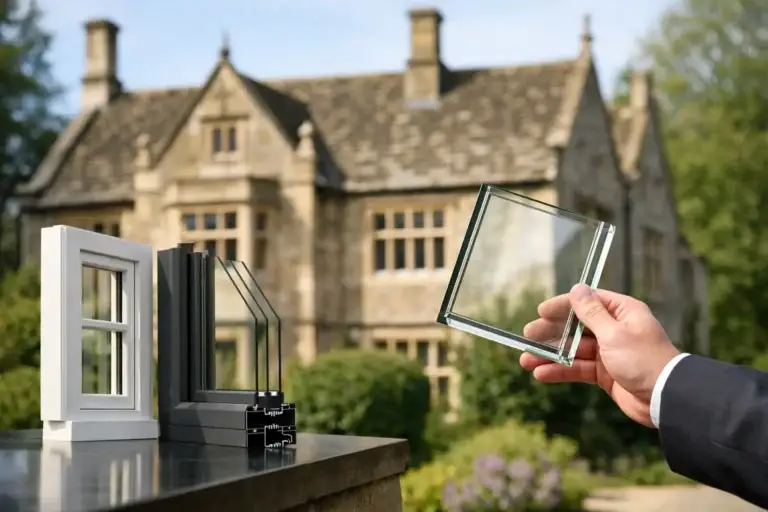
Vacuum insulated glass is especially compelling where thermal targets are aggressive and build-up depth is constrained. Heritage refurbishments are an obvious example. Many traditional frames cannot accept thick replacement units, yet occupants still expect meaningful gains in comfort, reduced heat loss and better control of external noise. A slim vacuum unit can make those objectives more achievable without forcing a wholesale visual compromise.
It also fits well in urban residential and hospitality projects where façade depth, energy standards and occupant comfort all compete for priority. In these schemes, a balanced vacuum glass specification can improve winter performance, reduce overheating risk when integrated into the broader façade strategy and limit noise ingress from roads or active streets.
Commercial façades, education buildings and specialist applications can benefit too, especially where lifecycle value matters. Lower operational energy demand, long service life and reduced façade bulk all contribute to a stronger whole-life case. If acoustic control is part of the value proposition, it should be engineered in from the start rather than assumed later.
How to specify for better acoustic results
The starting point is always the noise environment. A façade facing a dual carriageway requires a different response from one exposed mainly to intermittent pedestrian noise. Acoustic targets should be set using the relevant assessment data, then translated into glazing, frame and installation requirements.
From there, pane composition becomes critical. Laminated options, asymmetrical thicknesses and tested combinations can shift performance materially. A slim unit selected purely for thermal metrics may not be the optimal acoustic choice. Equally, over-specifying the glass while ignoring the frame is wasted budget.
Procurement teams should also ask a straightforward question: is the stated acoustic figure for the glass only, or for the full window or façade assembly? That distinction matters. For high-performance projects, decision-makers need evidence that reflects the installed reality.
For manufacturers and specifiers working on demanding envelopes, this is where specialist support has value. Werkman Tech positions vacuum insulated glass as a performance-led upgrade, and acoustic outcomes form part of that wider engineering conversation rather than a separate afterthought.
The trade-off to keep in view
Acoustic performance is never a single-number story. Strong results are possible, but they depend on the complete specification and the external sound profile. In some edge cases, a heavier or more complex glazing build-up may still be preferred if acoustic mitigation is the overriding project driver and frame depth is available. In many other cases, vacuum insulated glass provides the more commercially intelligent balance – exceptional thermal insulation, slim form, lower weight than bulkier alternatives and credible acoustic control in one advanced unit.
For decision-makers, that balance is usually the point. The best glazing specification is not the one that wins on one metric in isolation. It is the one that meets the project’s actual thermal, acoustic, aesthetic and lifecycle demands without creating avoidable compromises elsewhere.
If acoustic comfort matters on your next scheme, treat it as part of the primary glazing brief. The earlier vacuum glass is assessed against real noise data, frame design and installation strategy, the more likely it is to deliver the result the building needs.