Passive House projects rarely fail on ambition. They fail on details. A wall build-up can be exemplary, airtightness can be tightly controlled, and yet glazing still decides whether a design holds its thermal line in winter, limits overheating risk, and preserves usable daylight. That is why passive house vacuum glass has become a serious specification topic for architects, façade consultants and developers working to strict energy targets.
Vacuum insulated glass is not simply another route to a lower centre-pane U-value. It changes the balance between thermal performance, unit thickness, weight, durability and framing compatibility. For projects where every junction matters, that shift is commercially and technically significant.
What passive house vacuum glass is solving
Passive House design places unusual pressure on glazing. Windows and glazed doors must deliver very low heat loss, support internal comfort near the perimeter, and do so without forcing oversized frames, deep reveals or excessive structural compromises. Traditional double glazing often cannot meet that threshold. Triple glazing can, but it usually introduces bulk, weight and design constraints that are not always welcome.
Passive house vacuum glass addresses that problem by replacing the gas-filled cavity used in conventional insulated glazing with a vacuum space. Because there are virtually no gas molecules available to transfer heat across the cavity, conductive and convective heat transfer are dramatically reduced. The result is a very high-performing insulated glass unit in a much slimmer build.
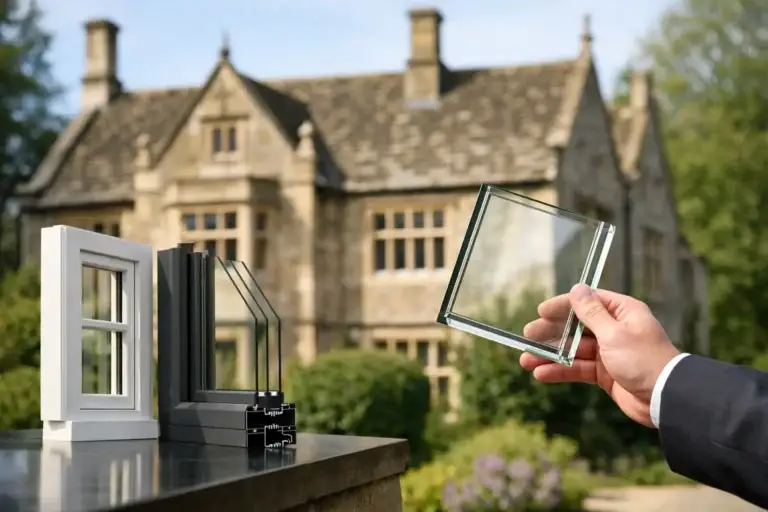
That matters in practice. Slimmer units can support retrofit scenarios, heritage-sensitive upgrades, refined frame profiles and façade designs where every millimetre has structural or visual implications. In new-build applications, it creates more freedom to pursue demanding thermal targets without defaulting to the heaviest glazing option on the market.
Why it matters in Passive House design
Passive House is not a product label. It is a performance standard built around measurable outcomes, especially space-heating demand, airtightness and thermal comfort. Glazing therefore needs to perform as part of a system rather than as an isolated component.
In that context, vacuum glass offers several advantages over conventional insulated units. The first is low thermal transmittance. Very low U-values are central to Passive House strategy, and vacuum insulated glass is engineered to reduce heat loss to a level that supports those targets. The second is perimeter comfort. Better glazing performance helps keep internal glass surface temperatures higher in cold weather, reducing the cold-radiation effect felt by occupants close to the window line.
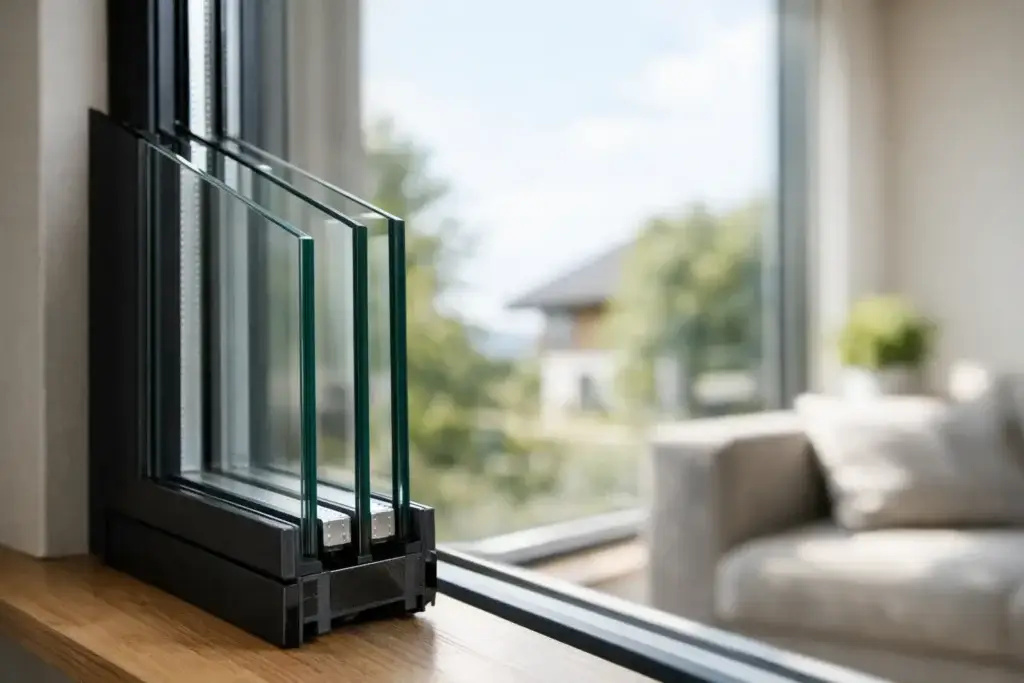
The third advantage is thickness. Triple glazing can deliver strong thermal performance, but its overall depth can complicate frame design, installation detailing and refurbishment work. Vacuum glass achieves comparable or superior insulation in a much thinner profile. For façade consultants and fabricators, that changes the specification conversation.
There is also the issue of weight. Heavier glazing has implications for handling, transport, hardware, frame engineering and lifecycle maintenance. A high-performance unit with less depth and lower weight can reduce those pressures while still supporting rigorous building-envelope performance.
Passive house vacuum glass vs triple glazing
This comparison is where many specifications are decided. Triple glazing has been the established answer for low-energy building for years, and in many projects it remains a valid solution. But it is not automatically the best one.
Thermally, vacuum insulated glass is highly competitive and often superior. Its construction is specifically engineered to limit heat transfer across the cavity to a much greater extent than gas-filled double glazing and, in many cases, beyond what standard triple glazing can achieve.
From a dimensional standpoint, the difference is more obvious. Triple-glazed units are substantially thicker. That added build-up can affect sightlines, frame sections, sash weights and refurbishment viability. In heritage and conservation contexts, where retaining slender visual proportions is critical, a slim high-performance unit can be the difference between approval and redesign.
Acoustically, the answer depends on the exact build-up. Vacuum glass can provide strong sound reduction, but acoustic performance is specification-dependent rather than automatic. Pane thickness, laminates, frame design and installation quality still matter. Where noise control is a major project driver, the glazing system should be assessed as a full assembly rather than selected on thermal numbers alone.
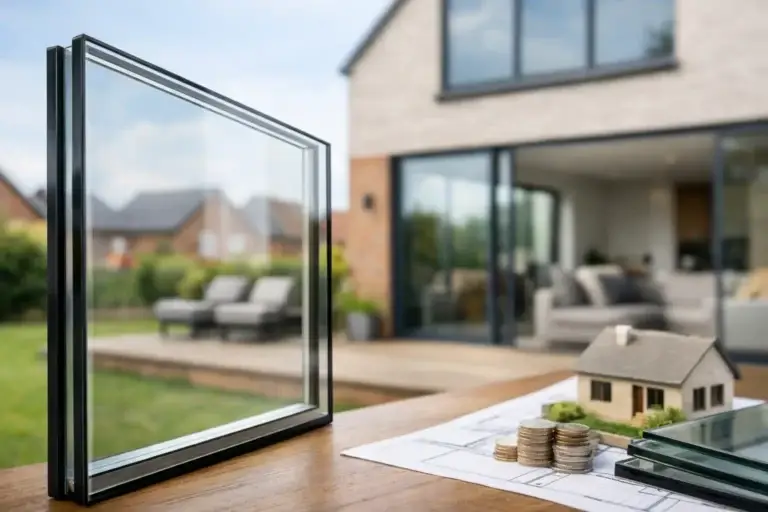
Cost is another variable. Vacuum insulated glass is a premium technology. On unit price alone, it may sit above standard alternatives. But serious buyers do not assess glazing on acquisition cost only. They assess operational savings, service life, maintenance implications, carbon reduction and the value of avoiding design compromises elsewhere in the envelope.
Where vacuum glass fits best
Not every building needs the highest-performing glazing on the market. But some project types benefit disproportionately.
High-end residential developments and certified passive house schemes are obvious candidates because thermal targets are uncompromising and occupant comfort is scrutinised closely. Heritage retrofits are another strong fit. Many older buildings need substantial energy improvement without losing traditional frame proportions or façade character. A slim vacuum unit can often achieve what thick triple glazing cannot do elegantly.
Commercial façades, education buildings and public-sector projects also benefit where lifecycle cost, compliance and long-term energy performance carry more weight than lowest-first-cost procurement. In these cases, the specification is often won on measurable outcomes rather than commodity pricing.
It is equally relevant in specialist sectors where thermal control is critical and glazing performance has a direct operational impact. That includes transport, agriculture, refrigeration and advanced façade applications. The common theme is simple: when heat loss, durability and system efficiency are commercially important, vacuum insulated glass earns its place.
The specification points that actually matter
Selecting passive house vacuum glass should not stop at headline U-values. Serious specification requires a more disciplined review.
First, confirm whether the stated figure is centre-pane or whole-window performance. Passive House decisions are not made on glass alone. Frame thermal performance, edge detailing and installation quality all influence the final result.
Second, examine compatibility with the intended framing system. A slim high-performance unit is only useful if it integrates correctly with the chosen window, curtain wall or specialist façade build-up. Spacer configuration, glazing pocket geometry and seal durability all matter.
Third, assess service life. One of the most compelling arguments for vacuum insulated glass is long-term value. That only stands up if the unit is manufactured to maintain vacuum integrity and resist degradation over time.
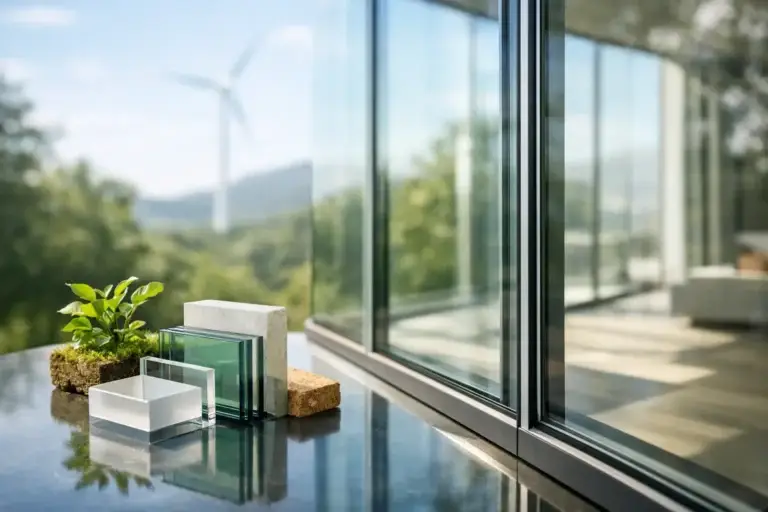
Fourth, look at embodied carbon alongside operational carbon. Triple glazing can improve thermal performance, but it also uses more material and adds weight. Vacuum technology can present a materially leaner route to very high insulation performance, which is increasingly relevant in whole-life carbon assessments.
Finally, keep expectations realistic. Passive House performance does not come from one component. Even leading glazing will underperform in a poorly detailed opening or a frame with weak thermal breaks. The glass must be part of an integrated envelope strategy.
Why the market is moving this way
The shift towards passive house vacuum glass is not a design fashion. It is a response to tightening regulations, tougher energy modelling, and more sophisticated clients. Buyers now expect proof, not promises. They want lower running costs, lower carbon impact and products that work hard over decades rather than just at practical completion.
That is exactly where vacuum insulated glass is strongest. It offers a direct upgrade path from conventional insulating glass by combining exceptionally low U-values, slim construction, strong acoustic potential and long-term performance in one unit. For specifiers balancing aesthetics with compliance, that combination is difficult to ignore.
This is also why manufacturers such as Werkman Tech position vacuum glass as a performance-led replacement for standard double and triple glazing rather than a niche speciality. The commercial case is no longer confined to unusual projects. It is increasingly relevant wherever premium envelope performance is expected.
The real trade-off
The real trade-off is not whether vacuum glass works. It does. The question is whether the project benefits enough from its performance advantages to justify premium specification.
If the scheme has generous frame depths, low sensitivity to weight, modest thermal targets and a cost plan built around standard solutions, triple glazing may remain the pragmatic choice. But where the brief demands lower U-values, slimmer profiles, reduced mass, retrofit compatibility or stronger lifecycle value, vacuum insulated glass is often the more intelligent route.
That is especially true in Passive House work, where marginal gains are not marginal at all. They shape certification risk, comfort outcomes and energy use for the life of the building.
For project teams aiming to build once and build properly, passive house vacuum glass is less about following a trend and more about specifying glazing that matches the standard the rest of the envelope is already trying to achieve.