When a project needs lower U-values without the bulk of triple glazing, the question usually appears early in the specification process: what is vacuum insulated glass? The short answer is that it is a high-performance glazing unit made from two panes of glass separated by a very thin vacuum cavity. That vacuum dramatically reduces heat transfer, allowing the unit to deliver exceptional thermal insulation in a slim profile.
For architects, façade consultants and contractors, that definition is only the starting point. The real value of vacuum insulated glass lies in how it solves several specification pressures at once – thermal performance, sightline constraints, acoustic comfort, weight, longevity and carbon reduction. In many demanding applications, it is not simply an alternative to conventional insulating glass. It is a materially better-performing system.
What is vacuum insulated glass and how does it work?
Vacuum insulated glass, often shortened to VIG, is a sealed glazing unit that uses a vacuum between two sheets of glass instead of the gas-filled cavity found in standard double glazing. Because there are almost no gas molecules in the cavity, conductive and convective heat transfer are drastically reduced.
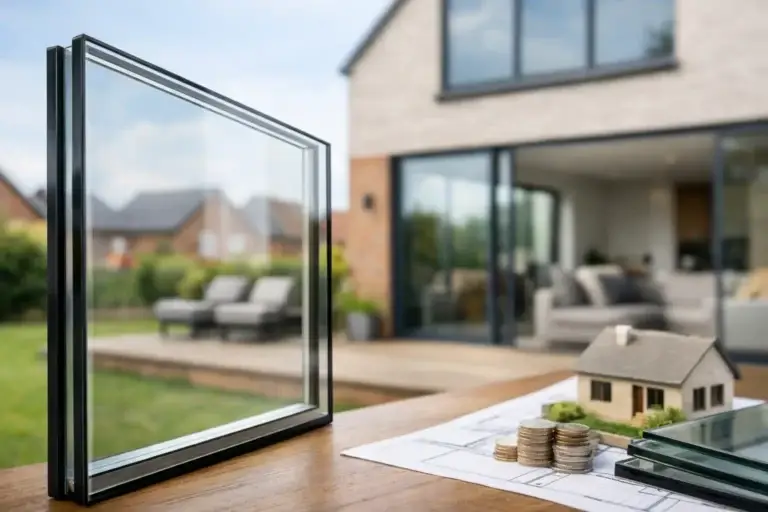
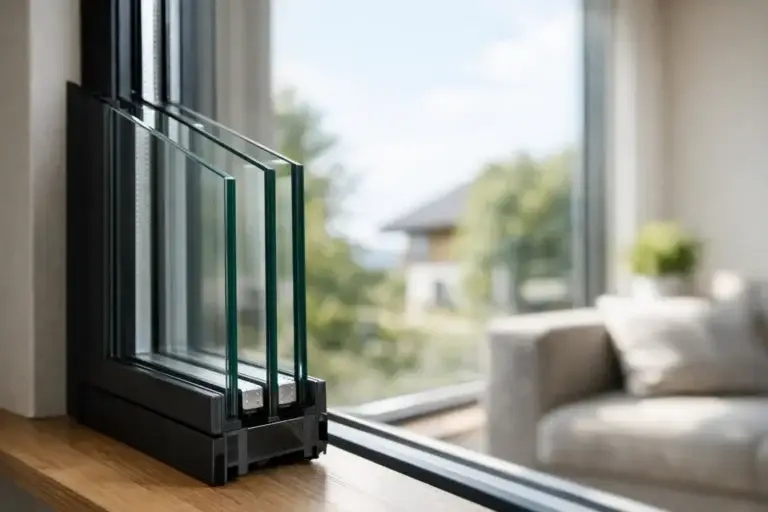
The construction is precise. Two panes are brought together with a microscopically thin gap between them, typically maintained by a grid of tiny support pillars. The perimeter is hermetically sealed, and the cavity is evacuated to create the vacuum. A low-emissivity coating is usually applied to improve thermal performance further by limiting radiative heat transfer.
This matters because conventional double glazing still allows a meaningful amount of heat movement through the gas in the cavity. Triple glazing reduces that flow by adding another pane and another cavity, but it does so with extra thickness and weight. Vacuum insulated glass approaches the problem differently. Instead of adding bulk, it removes the medium through which heat travels.
The result is a glazing unit that can achieve very low centre-pane U-values while remaining much thinner than most triple-glazed alternatives. For projects where frame depth, façade weight or heritage constraints are in play, that difference is commercially significant.
Why vacuum insulated glass performs differently
Thermal performance is the first reason most specifiers consider VIG. In a standard insulated glass unit, heat is transferred by conduction, convection and radiation. Vacuum insulated glass tackles all three with unusual efficiency.
The vacuum suppresses conduction and convection within the cavity because there is almost no matter present to carry heat. Low-e coatings reduce radiant heat transfer across the space. Together, these mechanisms allow VIG to reach insulation levels that would otherwise require much thicker systems.
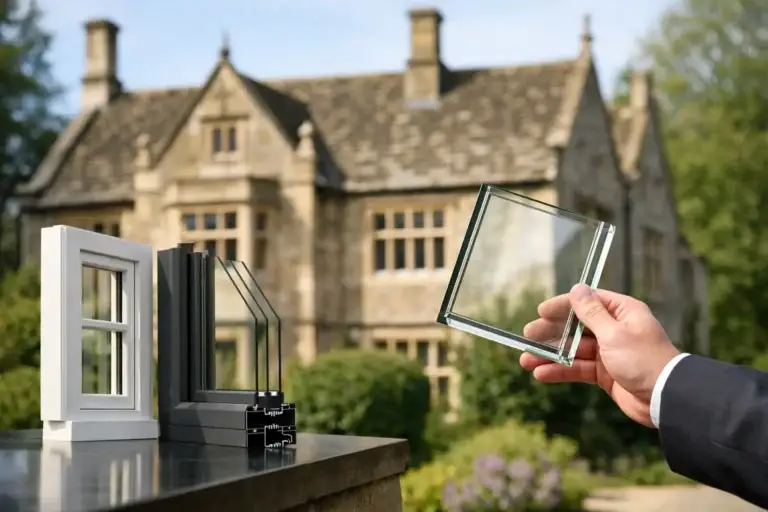
That slim construction changes the design equation. A thinner insulating unit can make it easier to retain elegant frame sections, upgrade existing window systems, or reduce the need for bulky framing around a high-performance façade. In retrofit and heritage work, where appearance and dimensional compatibility are often non-negotiable, this can be the deciding advantage.
Acoustic performance is also relevant, although this requires proper assessment rather than broad assumptions. Vacuum insulated glass can provide strong sound reduction, but acoustic outcomes depend on the full make-up of the unit, the glass thicknesses, the framing system and installation quality. In transport, mixed-use and urban projects, those details should be engineered, not guessed.
How it compares with double and triple glazing
Double glazing remains common because it is familiar, widely available and relatively economical. For many baseline projects, it is sufficient. The limitation appears when energy targets tighten, internal comfort becomes more critical, or façade performance has to be achieved within restricted build-ups.
Triple glazing improves insulation, but there is a trade-off. It adds thickness, weight and often complexity. That can affect frame design, transport, handling and installation. In some applications, it also pushes glazing dimensions beyond what existing systems were designed to accommodate.
Vacuum insulated glass offers a different route to high performance. It can deliver insulation closer to or beyond triple-glazed levels in a profile closer to single or slim double glazing. That matters for refurbishment, steel replacement windows, curtain walling, premium residential schemes and any project where thermal ambition collides with practical dimensional limits.
That said, it depends on the specification. Not every project needs VIG, and not every procurement route is set up for a premium performance product. If lowest upfront cost is the sole criterion, conventional units may still be selected. But when lifecycle value, energy savings, carbon reduction and design compatibility are factored in, the case for vacuum insulated glass becomes far stronger.
Where vacuum insulated glass adds the most value
VIG is particularly effective where performance targets are high and compromises are expensive. Heritage retrofit is an obvious example. Many older buildings require improved thermal performance without visibly altering frames, glazing bars or façade character. A slim, high-insulating unit can help bridge that gap in a way bulky triple glazing often cannot.
Commercial façades also benefit where thermal efficiency must be improved without imposing excessive weight on framing systems. Lower heat loss contributes to reduced operational energy demand, better occupant comfort and more stable internal conditions near the building envelope.
In Passive House and low-energy construction, the attraction is equally clear. Stringent thermal targets demand glazing systems that contribute meaningfully to whole-building performance. A product that delivers very low U-values in a thin construction gives specifiers greater flexibility in balancing façade design, structural constraints and energy modelling.
There are also specialist sectors where vacuum glass earns its place through performance density. Refrigeration, transport, agricultural buildings and building-integrated photovoltaic applications all benefit from glazing that combines insulation, durability and compactness. In these areas, the ability to extract more performance from less thickness is not a marginal gain. It directly affects system design.
The sustainability case is stronger than it first appears
Much of the discussion around glazing sustainability focuses on operational energy, and rightly so. Better insulation reduces heat loss, lowers heating demand and supports long-term energy savings across the service life of a building. Vacuum insulated glass performs strongly here because the thermal benefit is immediate and continuous.
But the environmental argument is broader. A thinner, lighter high-performance unit can reduce material demand compared with thicker multi-pane alternatives. Over time, durability and long service life also matter. A product that maintains performance and avoids premature replacement improves lifecycle outcomes, not just specification headlines.
For clients tracking embodied carbon as well as operational carbon, this is increasingly relevant. The best glazing choice is rarely the one with the simplest headline cost. It is the one that performs across decades, limits energy demand, supports compliance and reduces the need for early intervention.
What specifiers should look at before choosing VIG
The right question is not just what is vacuum insulated glass, but whether a given VIG specification is fit for the project. U-value is critical, but it should not be considered in isolation. Glass size, safety requirements, edge detailing, frame compatibility, acoustic targets and installation conditions all affect real-world performance.
Perimeter sealing technology deserves attention because it is fundamental to maintaining the vacuum over the product life. Support pillar design, glass make-up and manufacturing quality also matter. In a high-performance system, precision is not a marketing detail. It is the basis of durability.
Specifiers should also assess the complete assembly rather than the centre-pane figure alone. Whole-window or whole-façade performance depends on how the glass interacts with frames, spacers, gaskets and fixing details. A strong VIG unit placed into a weak system will not deliver the full benefit available.
This is where specialist support adds value. Performance-led manufacturers such as Werkman Tech approach vacuum insulated glass as an engineered solution, not a commodity pane. That distinction matters when compliance, energy modelling and long-term reliability are all on the line.
Why the market is paying closer attention now
The rise of vacuum insulated glass is not driven by novelty. It is driven by pressure. Building standards are tightening, energy costs remain a commercial concern, and clients increasingly expect better performance from every element of the envelope. At the same time, design teams are being asked to preserve aesthetics, reduce carbon and avoid unnecessary structural penalties.
Conventional glazing approaches can meet some of those demands, but often not all of them at once. VIG is gaining ground because it resolves that conflict more effectively. It offers a route to serious insulation without the usual penalty in depth and weight.
For decision-makers, that makes it more than an interesting technology. It makes it a practical specification tool. When façade performance must improve and the project cannot absorb the compromises of thicker glazing systems, vacuum insulated glass moves quickly from option to answer.
The most useful way to think about it is this: vacuum insulated glass is not simply thinner glazing with better numbers. It is a high-precision thermal barrier that allows the building envelope to do more with less – less thickness, less heat loss and less compromise.